Introducing Atlas, your new AI travel assistant for real-time Eurostar train information
Eurostar's high-speed trains make travel easier, more sustainable, and more enjoyable for millions of passengers. Operating a vast rail network that connects city centers across France, Belgium, Germany, the Netherlands, and the UK, Eurostar coordinates a complex web of trains, itineraries, and travellers. Yet, occasional disruptions, delays, and cancellations are inevitable in international travel.
That’s when Atlas steps in.
Discover how we developed Eurostar’s AI Voice Assistant to support their Contact Center, reducing both the workload of support agents and the wait times for travellers.
Scroll down to read the full case ↓
25%
OF CALLS WITH ATLAS ABOUT TRAIN INFO
38s
HANDLING TIME FOR TRAIN INFO CALLS
80%
OF TRAIN INFO CALLS SOLVED BY ATLAS
the problem
From track to phone: The bottleneck of train disruptions
Eurostar travellers can rely on the Contact Center, where agents stand ready to assist with bookings, exchanges, and cancellations. This system runs smoothly under business-as-usual conditions. However, the moment travel disruptions occur, agents face an overwhelming wave of calls as passengers want to know if and how they will be affected and what their next steps should be. During these high-volume surges, phone queues can reach up to 20-minutes wait times, turning an already stressful situation for passengers into an even more frustrating experience.
the solution
Meet Atlas: Eurostar's AI Voice Assistant
With Atlas, we set out to tackle two use-cases:
Providing fast and reliable real-time updates about train statuses (on time, cancelled, delayed),
and answering follow-up questions related to train disruptions, such as refund and ticket exchange options
Real-time train status updates
To provide passengers with the latest updates to their train, Atlas only requires the train number and day of travel. As soon as the traveller provides these journey details, Atlas can immediately let the caller know whether their train will depart on time, be delayed, or cancelled.
Atlas is based on a Large Language Model (LLM), allowing it to understand natural human speech. No matter if the caller provides the day of travel as a date, weekday, or relative time reference (ex: "in two days"), Atlas will understand and find the correct train.
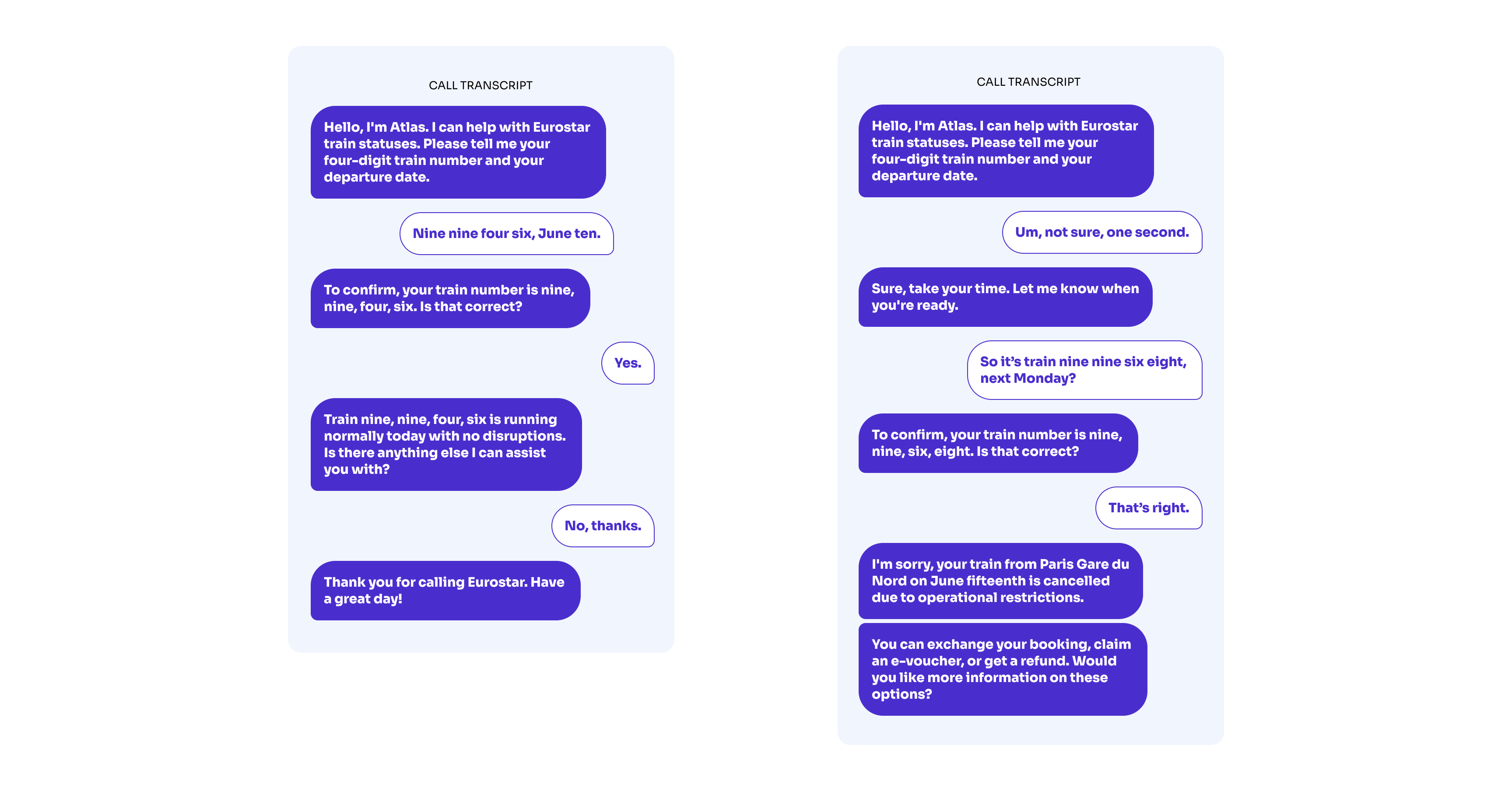
Transcripts of calls about train information
Compensation and FAQ information
When a train is cancelled or severely delayed, receiving the status update might not be satisfactory. To help travellers further, Atlas can explain how to exchange a ticket, request a refund or claim an e-voucher. Backed by a knowledge base of Eurostar information, Atlas's answers are reliable, precise, and accurate.
In addition to compensation guidance, the AI Voice Assistant can answer several FAQ-topics, from how to book a journey to knowing when to arrive at the station. Should a passenger require help with a topic outside of Atlas's scope, such as disability assistance or booking modifications, it smoothly transfers them to the wait queue to speak to a human agent.
A bot that does not sound robotic
When tackling these two use-cases, the goal was not only to provide fast, accurate information, but to provide it within a frictionless calling experience.
Operating in English, French, Dutch, and German, Atlas understands spontaneous human speech, handling natural pauses, hesitations, and conversation-course corrections with ease. Its own voice mimics human speech patterns, using realistic intonations and dynamic responses to ensure the feeling of a natural conversation.
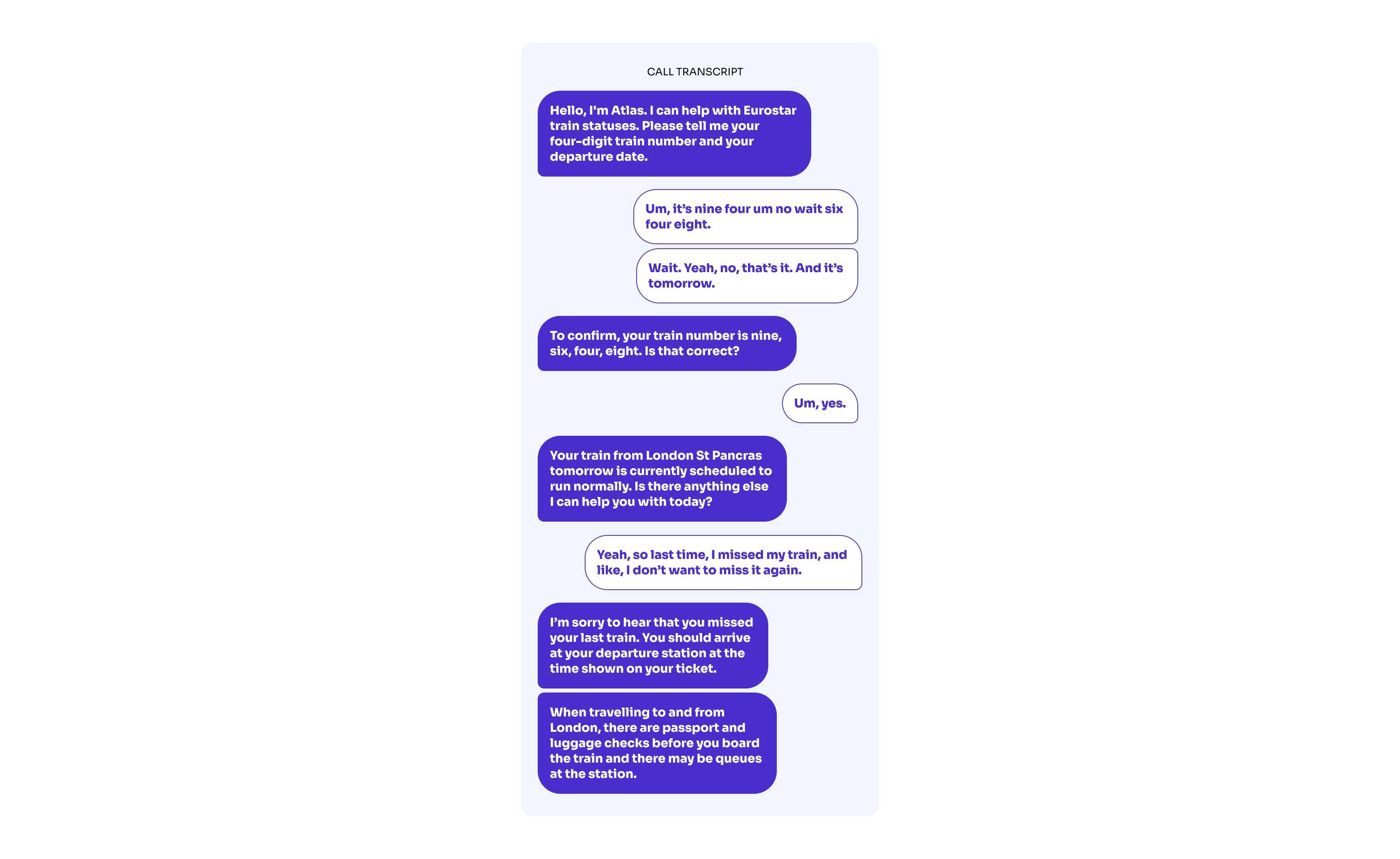
Transcript of a call
the results
A smoother, faster call experience
Currently, Atlas is integrated into an Interactive Voice Response (IVR) menu, where callers are routed to the correct help department based on their needs. Travellers who want to know if their train runs on time, reach Atlas.
During its first month of helping passengers, 25% of all calls routed to Atlas were related to receiving train status updates. Amongst these callers, 70% were purely looking for train status updates, with no follow-up questions. Atlas resolved 80% of these calls on its own, delivering accurate, real-time information and wrapping up the conversation in an average of only 32 seconds.
For the remaining calls that covered additional topics, Atlas resolved 45% of them without transferring to a human agent, bringing the call time down to a swift average of 54 seconds.
Overall, Atlas provided accurate and complete information to 60% of travellers that interacted with it, significantly reducing call time and agent workload. Of course, some topics or situations still required a human agent. Yet, only 40% of transfers were requested by the caller, while the majority were proactive decisions made by Atlas, when it recognized the need for human expertise.
What's next for Atlas?
Looking ahead, Atlas's knowledge base is set to expand rapidly, greatly widening its scope. While it currently focuses on a selected set of topics, the goal is for it to become Eurostar's frontline call assistant, replacing the IVR menu altogether and allowing human agents to focus exclusively on the most complex passenger needs.
Talk with a human
If you want to discuss AI in more detail, then reach out to Alexis.
We use cookies to provide you with the best browsing experience and analyze our website traffic. By clicking "Accept All", you consent to our use of cookies. You can customize your preferences or view our Privacy Policy for more information.
.png)